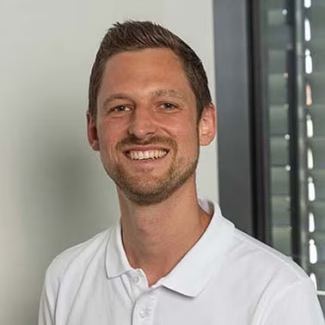
As announced in our last blog post, today we’re going to talk to the man who helped develop the newest addition to our HeBoSint® STRONG LINE.
Hi Dominik, we’re glad you were able to take the time today to talk to us about the development of a new boron nitride material. Could you tell us a little more about yourself and your role?
Dominik Zug: Hello, thank you for giving me the opportunity to talk about the new material today. My name is Dominik Zug, and I have been working at Henze BNP for six years as a senior development engineer.
How did the idea to develop your own materials come about, and how long did it take?
Dominik Zug: In fact, this idea has evolved over several years thanks to Henze’s extensive experience and customer relationships. In recent years, it has become clear that there are applications where the properties of existing boron nitride materials are insufficient. The actual starting point for material development was back in 2017, when we began working on both material development and the development of a suitable manufacturing process as part of a ZIM project funded by the BMWK.
What kind of challenges does a project like this present? Who’s involved? Did you do it all on your own? What stands out most in your memory?
Dominik Zug: Ultimately, such a development process always involves conflicting objectives. Identifying an economical processing method that yields the best possible quality is just one example. Of course, there are also technical conflicts of interest. One example is the material’s compaction behavior, which often conflicts with its subsequent thermal stability. Of course, we also need to achieve the most efficient machining possible, which is naturally higher, especially with soft, low-density materials. I think these examples illustrate quite well that such challenges can only be solved as a team. The active support of external development partners, such as the Fraunhofer IKTS in Dresden, or internal departments like production planning, product management, or cost accounting, plays a crucial role.
So what makes this new material so special? Is the hot press up and running yet? Are you proud of it?
Dominik Zug: I think this material really illustrates what our focus is at Henze. It was developed in collaboration with a pilot customer. The goal here was to achieve optimal wear resistance when in contact with molten metals. Furthermore, additional analyses show that with the chosen material combination, we achieve very high electrical insulation properties, which—compared to pure boron nitride grades—are achieved primarily for relatively high strengths. Of course, we also had to navigate a learning curve with the integration of hot-pressing technology, which was new to us. However, we can now say that, thanks to our motivated and technology-savvy production staff, we have our process under control. Looking back, we can certainly be proud to have been part of a team that helped achieve such a milestone in the company’s history. Nevertheless, looking to the future is comparatively more interesting.
When will the new material be available? What does the future hold? Can you give us a hint here?
Dominik Zug: The material is available immediately. It’s hard to predict what the future holds. Nevertheless, we are naturally focusing on other materials that could offer solutions to specific challenges faced by our customers and potential customers. We expect that, based on the SL-N 300, we will also be able to develop formulations that offer advantages in the field of metal casting. Here, adjustments regarding mechanical wear resistance or thermal shock resistance are conceivable.
Why was this particular material chosen? What advantages does it offer users compared to other materials?
Dominik Zug: Given the conflicting objectives outlined, we believe our material offers the best possible solution. This means that we have found a good balance to offer the customer a component that can be machined efficiently and with dimensional accuracy, exhibits good mechanical wear resistance, and demonstrates this even at high temperatures and under additional chemical stress, such as from molten metals. In direct comparison to other materials, a lower degree of contamination of the melt can be expected. Likewise, the comparatively high strength and high electrical insulation properties allow for an extended service life.
Für welche Anwendungen siehst Du diesen Werkstoff?
Dominik Zug: Given the advantages and added value described above, this material is ideally suited for foundry applications, such as various remelting processes, thin-strip casting, or components in horizontal continuous casting. An increase in service life is also expected in coating systems where our components are used as electrical insulation parts that exhibit optimal separation properties relative to the coating material. We are already looking forward to Ceramitec in Munich to explore the areas not yet covered. At the trade show, interesting discussions and ideas are sure to emerge, most of which will be sparked by existing customer-specific challenges.