In this blog post, we’ll take a closer look at melt fracture, a problem that the plastics industry faces, particularly in extrusion processes.
PFAS Ban – Boron Nitride as a Substitute
The impending ban on substances in the PFAS family also includes polytetrafluoroethylene (PTFE), which is used in many applications due to its unique friction properties and chemical resistance. Industries that use PTFE as an aid in polymer processing for products such as films, seals, and sliding bearings must seek alternatives to meet the new market demands for PTFE-free products.
We asked our product managers, Michaela and Tobias, about the current debate:

“We need to take a nuanced approach to this issue. Despite all the criticism, many substances in the PFAS class are genuine miracle solutions that serve a legitimate purpose. As with everything in life, it’s the dose that makes the poison. That’s why we need to examine the issue thoroughly and ask ourselves in which areas fluoropolymers can be meaningfully substituted.”
Tobias Dangel

“In the case of PTFE, it can be said that whenever PTFE is used as an additive in other systems—such as plastics or lubricants—to modify and optimize tribological properties or wear, boron nitride can not only serve as an alternative but, thanks to its additional properties, offer real added value as a polymer processing aid and is also environmentally friendly.”
Michaela Schopp
Fracture of Plastics: Same Effect, Different Mechanism!
Melt fracture is a common problem in plastics processing that can lead to unwanted cracks and uneven surface textures. This phenomenon occurs particularly with high-viscosity polymers and significantly compromises the quality of the final product. The cause lies in the non-uniform flow velocity of the melt, which in turn is caused by wall friction. As the polymer melt exits, this results in a rough surface (Fig. 4).

PTFE is often used to reduce melt breakage; it acts as a lubricant and also reduces friction in the processing machinery. PTFE works as follows. Due to its affinity for metal, the PTFE migrates to the metal nozzle and forms a very thin “lubricating layer” there. This layer influences the flow velocity of the melt, thereby reducing wall friction and equalizing the flow velocities at the edge and in the center of the melt.

As a substitute for PTFE, boron nitride is the first choice due to its outstanding coefficient of friction, even at high temperatures. The mechanism by which melt fracture is prevented differs from that of PTFE. While PTFE influences friction at the melt front through its affinity for the metal nozzle, boron nitride reduces the shear viscosity of the polymer. The hexagonal BN particles disrupt the cross-linking density of the polymer chains, which reduces the number of interlocks/interactions between the polymer chains
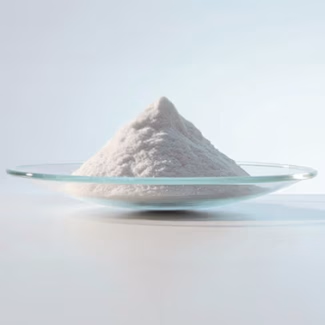
The interactions between hBN and the polymer chains reduce the polymer’s viscosity. This lowers the tensile stresses that can lead to melt fractures while simultaneously improving the polymer’s processability. As little as 100 to a maximum of 1,000 ppm of hexagonal boron nitride powder is sufficient to produce the aforementioned effects. Our HeBoFill® BL-SP 020 powder can be a suitable alternative here.
Unlike PTFE, hBN offers additional benefits:
– Less stringing
– Reduced need for nozzle cleaning
– Increased machine uptime
– Lower processing temperatures possible
– Maintenance of higher shear rates
– Extended service life of nozzles and other processing components in the extrusion process
– Reduced wear
Overlap of the properties of boron nitride and PTFE

Boron nitride in contact with food
For the production of packaging, particularly in the food industry, additives must have food-grade certification. Our HeBoFill powders are approved for use in plastic materials intended to come into contact with food, in accordance with EU Directive (EU) No. 10/2011. We also offer powders in our portfolio that meet FDA certification requirements.
Please contact our sales team for more information.
Link zur technischen Beratung: https://www.henze-bnp.de/service/technischer-vertrieb.php
Conclusion and Outlook
With the approval of boron nitride for use in food-contact plastics, the issue of melt fracture can be addressed despite the impending ban on PTFE. Thus, regardless of how the European Commission decides, a first step toward benefiting people, the environment, and technology can already be taken in certain areas.
Quellen:
Martin Sentmanat, Savvas G. Hatzikiriakos, Mechanismus zur Beseitigung von Grobbrüchen in der Schmelze bei der Extrusion von Polyethylenen in Gegenwart von Bornitrid, Springer, 2004
Igor B. Kazatchkov, Franky Yip, Savvas G. Hatzikiriakos, Der Einfluss von Bornitrid auf die Rheologie und Verarbeitung von Polyolefinen, Springer, 2000
https://www.bn.saint-gobain.com/applications/polymer-engineering/polymer-processing-aid, abgerufen am 21.08.2024