Hexagonal boron nitride provides electrical insulation

Challenge
Many insulation materials offer only a limited solution for high-temperature and power applications, as they lose their electrical insulation properties once a certain temperature is reached.

Consequence
In many applications, electrical insulation and heat dissipation must be physically separated, resulting in the design of complex and less efficient systems. Thermal stresses accelerate material-related wear and, when combined with electrical stress, significantly shorten the service life of the components used.

THE HENZE SOLUTION
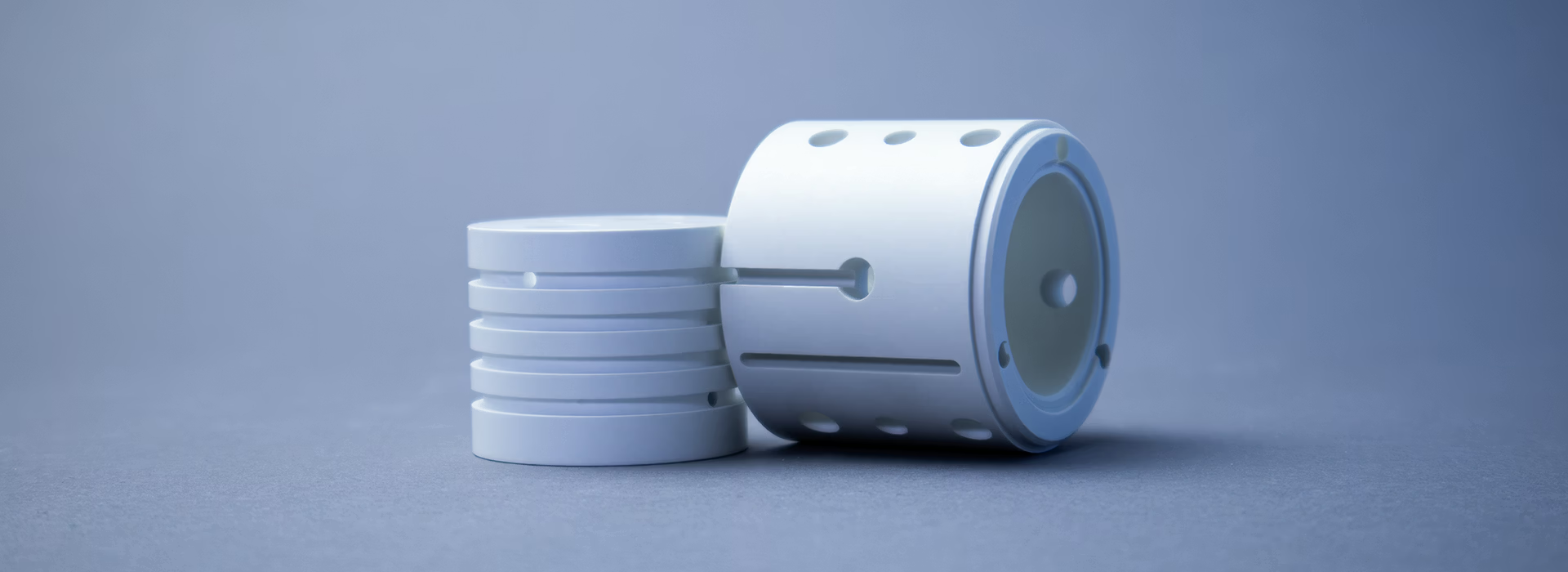
Components made of hexagonal boron nitride are the perfect solution! They combine insulation and heat dissipation in a single material. They maintain consistent electrical properties even at high temperatures and during thermal cycling, and ensure uniform temperature distribution.
Haven't found a solution?
Our team is happy to assist you.



Frequently Asked Questions
Why is the combination of electrical insulation and thermal conductivity often a challenge in industry?
In many high-temperature and energy applications, there is a seemingly contradictory requirement: components must provide reliable electrical insulation while simultaneously dissipating heat efficiently and withstanding extremely high temperatures. Conventional materials quickly reach their limits in this regard. Boron nitride, on the other hand, is a high-temperature-resistant industrial ceramic that combines precisely these versatile properties.
In which industrial applications is electrical insulation using boron nitride particularly important?
Boron nitride is used wherever maximum precision is required under extreme conditions. Typical examples include high-temperature furnace construction, where HeBoSint® materials are used as electrical insulation sleeves for heaters. In solar technology (photovoltaics), electrically insulating boron nitride ceramics protect the sensitive graphite or copper heating elements in the production of silicon wafers. Even in space, for example in plasma drives for satellites, the electrical insulation provided by boron nitride prevents short circuits and ensures a constant electrical field. It is also the proven material in PVD systems, where it ideally combines insulation, temperature resistance and non-stick properties.
How can plastics be made thermally conductive without losing their electrical insulation properties?
As plastics naturally have no significant thermal conductivity, but their use in the electronics sector, for example, is constantly increasing, intelligent thermal management is required. Our HeBoFill® boron nitride powders are ideally suited as fillers to significantly increase the thermal conductivity of plastics while fully retaining their excellent electrical insulating properties. For solid components with even more extreme requirements, we also offer the high-performance mixed ceramic HeBoSint® SL-A 800, which combines outstanding thermal conductivity with excellent electrical insulation properties (specific electrical resistance >10^15 Ohm).