Discover the versatility of our boron nitride products
Thanks to their outstanding release properties and thermal stability, our boron nitride products are indispensable in numerous industries. Depending on the application, we manufacture custom components for you that can withstand even the most extreme conditions in high-temperature applications. Discover the diversity of our four specialized product groups
Hebosint ® - Boron nitride components
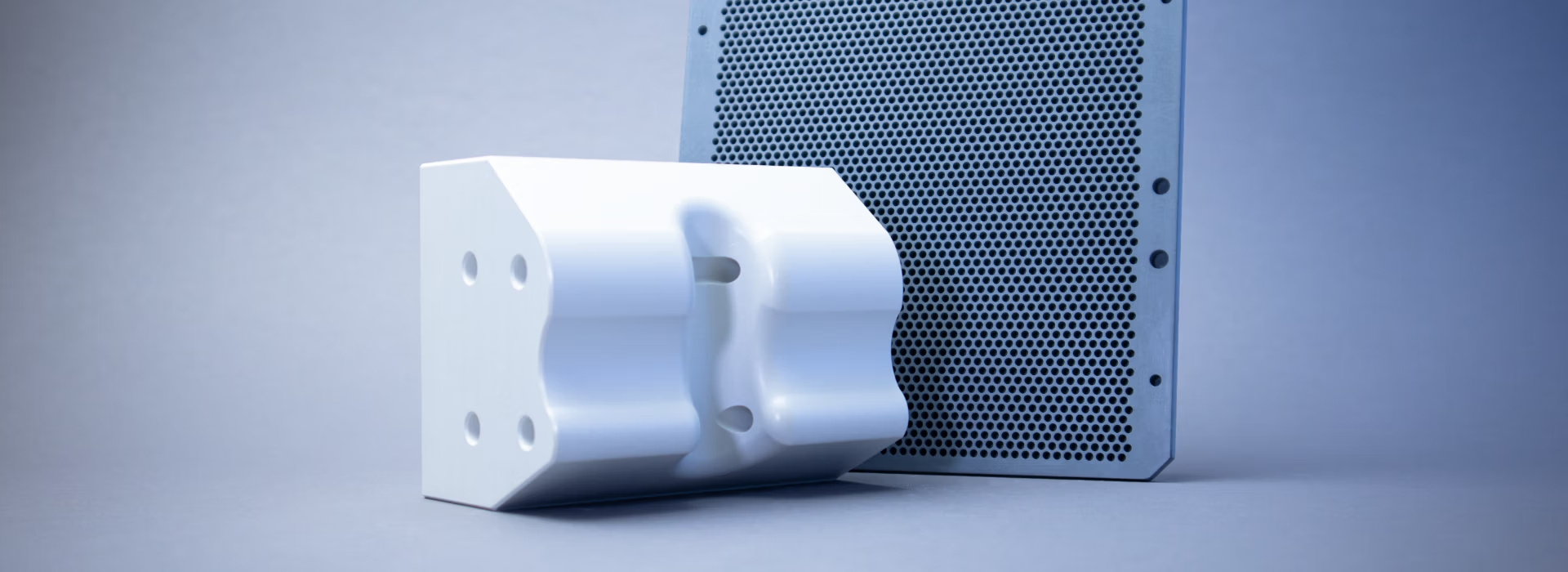
Our technical ceramics made of sintered boron nitride—whether in their pure form or as composite materials—are easy to machine, highly heat-resistant, and electrically insulating. They are therefore ideal materials and precision components for demanding high-temperature processes.
Key features:
Extremely high temperature resistance (up to over 2,000 °C in a vacuum), excellent electrical insulation, and chemical resistance.
Your benefits:
These ceramic components are ideal for durable, maintenance-free parts in high-temperature furnaces, foundries, or PVD systems. Sie erhöhen die Prozesssicherheit und verlängern die Lebensdauer Ihrer Werkzeuge.
Applications:
Fertigung und Anlagenbau, Metallurgie, Weltraumfahrt, Halbleiterindustrie uvm…

Hebocoat ® - Boron Nitride Coatings
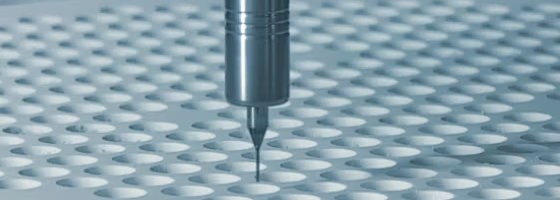
These water- or solvent-based liquid boron nitride coatings provide optimal release and lubrication properties in a wide range of applications
Key features:
Excellent release and lubricating properties, high temperature resistance, and resistance to wetting by molten metals, salts, and slag.
Your benefits:
These coatings prevent molten metal or welding spatter from adhering, which makes cleaning much easier and increases the efficiency and service life of your tools.
Applications:
Aluminum extrusion, metal and aluminum casting, welding and brazing technology, metal forming.

Hebofill ® - Boron nitride powder
We offer a wide selection of powders. Among other things, they serve as fillers to Improve the thermal conductivity of plastics while maintaining high electrical insulation. In addition, they provide essential release and lubricating properties in coatings.
Key features:
Highest thermal conductivity among electrically insulating fillers and excellent lubricating properties.
Your benefits:
Enables the production of innovative, thermally conductive plastics for the electronics industry. As solid lubricants, they optimize the high-temperature properties of oils and greases.
Applications:
Thermal management (electronics, LED technology), plastics technology, lubricant technology.
Hebolub ® - Boron Nitride Lubricant Additive
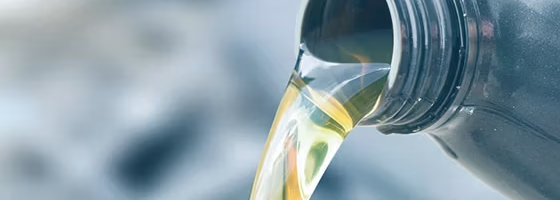
This innovative lubricant additive is characterized by highly concentrated boron nitride particles that are finely dispersed in oil. It has been proven to minimize friction and wear, optimize high-temperature performance in many tribological applications, and simultaneously improve the thermal conductivity of lubricants.
Key features:
Optimizes the high-temperature and emergency running properties of lubricants in tribological applications.
Your benefits:
Improves the performance and service life of your lubricants under extreme conditions and ensures process reliability.
Applications:
Lubrication Technology.
Do you have any questions about our products?
Our team is here to help.



Why Henze Products
What is boron nitride?
- Extreme temperature resistance: In an inert (oxygen-free) or reducing environment, boron nitride can easily withstand temperatures exceeding 2,000 °C.
- Outstanding thermal management: It offers excellent thermal conductivity and high thermal capacity, combined with very low thermal expansion.
- Electrical insulation: The material has a low dielectric constant and excellent dielectric strength, making it ideal for electrical components.
- Thermal shock resistance: Boron nitride remains extremely stable under extreme and abrupt temperature changes.
- Excellent release and lubricating properties: It has a naturally very low coefficient of friction and provides reliable lubrication even under extreme conditions.
- Chemical resistance: It is chemically inert and can withstand even aggressive molten metals.
What is boron nitride used for?
Here is an overview of the most important industrial applications:
- Metal and aluminum casting: Crucibles, nozzles, and molded parts are made from solid boron nitride because the material is extremely resistant to thermal shock and does not chemically react with molten metal. When used as a coating on channels, it prevents buildup and makes cleaning easier.
- Powder metallurgy (metal atomization): Boron nitride nozzles ensure an extremely high powder yield, reduce waste, and enable precise control of particle shape and size.
- High-temperature furnace construction: It is used as a heat-resistant electrical insulation sleeve, heating element support, or thermocouple protection tube and ensures safe process control.
- Sintering technology: Used as a sintering support or coating, it reliably separates the sintered material from the substrate, prevents sticking, and protects components from unwanted carburization.
- Metal Forming & Extrusion: During drawing, rolling, or aluminum extrusion, boron nitride acts as a highly effective high-temperature release agent and lubricant, replacing traditional agents such as carbon black. It also ensures clean processes in superplastic forming (SPF).
- Welding, brazing, and laser processing: Coatings and sprays reliably protect workpieces and welding nozzles from metal spatter. In laser cutting, boron nitride reduces burr formation and protects against oxidation and soot marks.
- PVD and plasma systems: Metallic shielding frames are coated using these systems to save valuable cleaning time thanks to the non-stick effect and to ensure electrical insulation.
- Thermally Conductive Plastics (Thermal Management): Boron nitride powders are ideal fillers for significantly increasing the thermal conductivity of plastics (e.g., for electronics) without compromising their electrical insulation properties.
- Lubricants: As an oil additive, it minimizes wear and friction, thereby reducing energy and fuel consumption. It also serves as a future-proof alternative to PTFE and is partially NSF-certified (Category HX-1) for use in lubricants that may come into occasional contact with food.
- Aerospace: Boron nitride has proven its worth in plasma thrusters for satellites under the most extreme conditions. It provides electrical insulation (preventing short circuits), does not chemically react with the plasma, and withstands the extreme temperature variations in space.
- Solar and semiconductor technology: In the manufacture of silicon wafers for solar modules, it protects the sensitive graphite and copper heating elements. High-performance mixed ceramics (such as HeBoSint® SL-A 800) are used in state-of-the-art power and semiconductor electronics.
- Hydrogen economy: Boron nitride powder serves as a diffusion barrier to improve the sealing performance of materials used in hydrogen storage and transport and to minimize emissions.
In what forms does boron nitride come?
- Solid Form (Sintered Components): In its solid form, boron nitride is often referred to as “white graphite” due to its structure. The material is hot-pressed under high pressure and temperature into large blocks or billets, from which high-precision and complex components are subsequently manufactured. At Henze BNP, these thermally conductive and electrically insulating components are known under the HeBoSint® product family.
- Powder Form: Boron nitride powders are available in a wide range of grades and are primarily used as functional fillers. They are used, for example, to make plastics thermally conductive (thermal management) or as solid lubricants. These powder products are available from Henze under the brand name HeBoFill®.
- Liquid Form (Coatings / Suspensions): Boron nitride is used as a water- or solvent-based liquid suspension to apply or coat surfaces. This provides excellent release and lubrication properties, e.g., in metal casting. These coatings are part of the HeBoCoat® product family.
- Aerosol form (sprays): For particularly easy, quick, and precise application, boron nitride is also available as a spray. This is ideal for pressure sintering on small surfaces or for protecting welding and brazing fixtures. At Henze, sprays are also part of the HeBoCoat® product group (Spray Line).
- Lubricant additive (oil dispersion): In this form, ultra-fine boron nitride particles are present in a highly concentrated and finely dispersed state within an oil. When used as an additive in conventional lubricants, it has been proven to minimize friction and wear in engines and transmissions. This liquid additive is marketed under the name HeBoLub®.
What is the difference between cubic and hexagonal boron nitride?
- Cubic boron nitride: This form has a crystal structure similar to that of diamond and, as a result, exhibits similar properties. The most important characteristic of cubic boron nitride is its extreme hardness, which is why it is often used as a substitute for diamond in industrial applications.
- Hexagonal boron nitride: Unlike the cubic form, hexagonal boron nitride is relatively soft. It is readily available commercially and can be processed into large blocks (ingots) in its solid form. Its outstanding strengths lie not in its hardness, but in its ability to withstand extremely high temperatures, its excellent electrical properties, and its resistance to aggressive molten metals.
How does boron nitride differ from conventional graphite?
- Excellent electrical insulation: While conventional graphite is electrically conductive, boron nitride is an excellent electrical insulator. This property makes it indispensable for applications in which components must simultaneously dissipate heat efficiently and provide reliable electrical insulation (such as in semiconductor technology or high-temperature furnace construction).
- Significantly higher oxidation temperature: Unlike graphite, boron nitride has a much higher oxidation temperature. This means that it does not burn upon contact with oxygen until much higher temperatures are reached, making it significantly more resistant and stable in thermally extreme environments.
Can boron nitride also be used in the food industry?
- Lubricants for food processing: Certain boron nitride powders from Henze BNP (such as HeBoFill® LL-SP 010 and HeBoFill® LL-SP 050) are NSF-certified (Category HX-1). These powders may be used as additives in lubricants where incidental contact with food may occur. This allows their use directly in and around food processing production facilities. In addition, boron nitride lubricants have received the necessary FDA and EU approvals for food contact.
- Lebensmittelverpackungen: Bornitrid wird zudem als funktionaler Füllstoff für Polyolefin-Folienblasen genutzt, welche bei Lebensmittelanwendungen zum Einsatz kommen.
Why should I choose boron nitride products from Henze BNP?
As a family business, we have specialized exclusively in the production, distribution and development of hexagonal boron nitride products for more than 30 years. We are characterized by in-depth expertise, a high level of innovation and individual customer advice. This enables us to provide you with tailor-made solutions for the most technically demanding applications from a single source – from the initial idea to the finished product.
Does Henze BNP stand for "Made in Germany" quality?
Yes, absolutely. We manufacture our boron nitride products directly at our company site in Lauben (southern Bavaria). Our quality and environmental management is strictly and reliably certified in accordance with ISO 9001 (since 2002) and ISO 14001 (since 2019).
How sustainably are Henze BNP's products manufactured?
Sustainability is deeply rooted in our DNA. Thanks to our in-house photovoltaic systems, we achieve a self-sufficiency rate of just over 60% during the summer months. The remaining electricity we need is sourced entirely from renewable sources. Thanks to a sophisticated energy recovery concept, we manufacture our boron nitride sintered bodies using 100% renewable energy—and, in the best-case scenario, 40% more energy-efficiently compared to conventional manufacturing processes. In addition, we cover a large portion of our heating needs in an environmentally friendly manner through the recovery of process heat.
What ethical principles does Henze BNP adhere to?
We take responsibility for people and the environment. Since 2024, we have been successfully certified as a company according to the strict criteria of the Economy for the Common Good (ECG). Our ethical business culture also means that we consciously refrain from working with companies from the nuclear energy sector (extraction of uranium or production of nuclear energy) and the arms and weapons industry when selling our products.
Are the products cost-effective and safe to use?
Yes, for example, our products reduce energy and fuel consumption by reducing friction and extend the product life cycle through optimum wear protection. In addition, boron nitride is physiologically harmless, very compatible with plastics and seals and retains its effect even under the most extreme conditions. Certain HeBoFill® powders are even NSF-certified (category HX-1) for use in lubricants with unintended food contact.
What are the characteristics of a machinable technical ceramic such as boron nitride?
Technical ceramics such as boron nitride are advanced synthetic materials which, particularly in their sintered, solid form, are characterised by excellent and easy machinability. The material, often referred to as ‘white graphite’ due to its microstructure, can be shaped into highly complex geometries and to extremely tight tolerances in virtually any desired form. A key economic and technical advantage of this machinable ceramic is that the dense material is ready for use immediately, meaning that no additional heat treatment or further firing is required after mechanical machining. This property allows for an enormous variety of geometries in production.
What properties make boron nitride a particularly sought-after technical ceramic for industrial applications?
As an engineering ceramic, boron nitride is a truly versatile material that combines seemingly contradictory physical properties in a single substance. In addition to its outstanding machinability, it offers excellent thermal conductivity and high heat capacity, whilst also possessing excellent electrical insulating properties (low dielectric constant and high dielectric strength). Furthermore, the ceramic can withstand extremely high thermal loads and copes effortlessly with abrupt temperature shocks. This unique combination makes dense boron nitride (such as the HeBoSint® grades) the ideal solution for the most demanding high-temperature processes, where conventional materials reach their limits.