Hexagonal boron nitride combines superior electrical insulation with excellent thermal conductivity

Challenge
Rising power densities, increasingly compact designs, and higher process temperatures are significantly raising the bar for efficient thermal management across virtually all industrial sectors. Whether it’s thermal management in electric mobility, thermally conductive insulation systems in power electronics, or targeted heat dissipation in high-temperature processes, a material’s thermal conductivity is increasingly becoming a key economic factor in decision-making.

Consequence
High-power components are prone to heat buildup, which significantly reduces system efficiency and limits the maximum achievable power density. The resulting thermal stress leads to premature aging of the components and necessitates increased cooling requirements. To ensure operational reliability, systems often have to be oversized. This significantly increases total cost of ownership.

THE HENZE SOLUTION
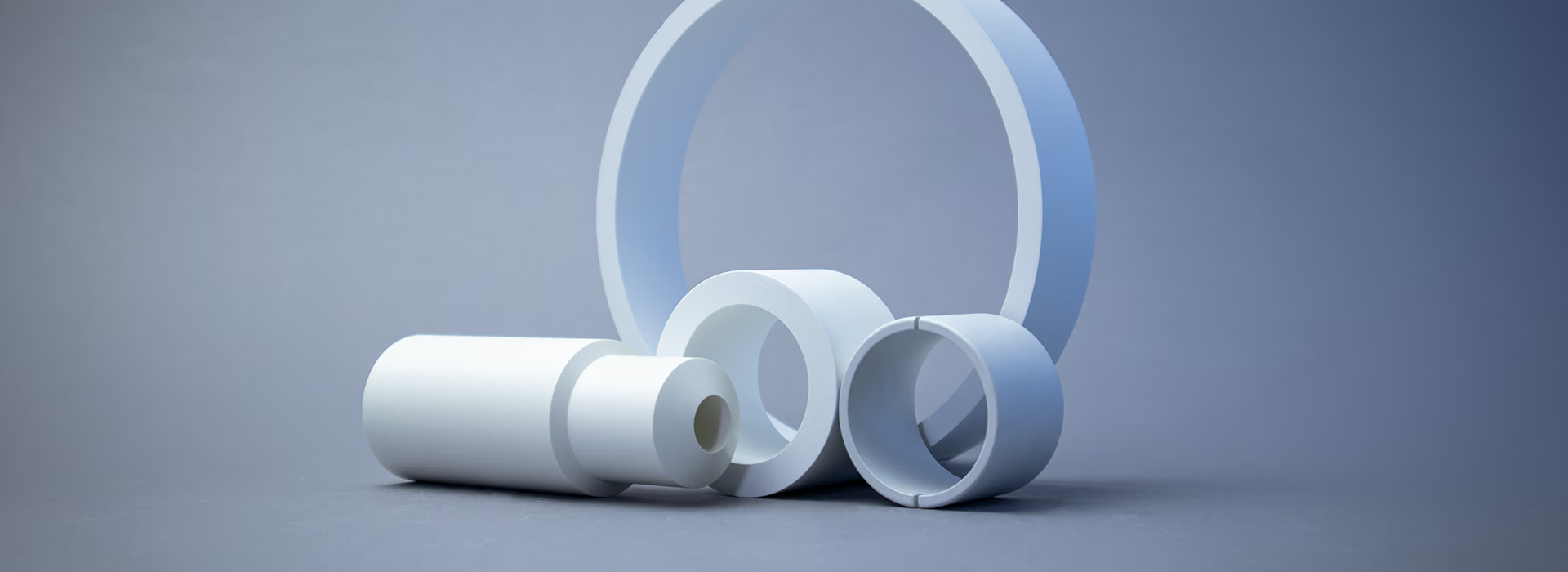
Boron nitride is used in numerous applications—both as a component and as a functional filler. As a component, it serves, among other things, as an electrical insulating material in high-temperature furnaces, for example in heater supports or insulating sleeves, as well as a substrate for printed circuit boards. As a filler, boron nitride increases the thermal conductivity of plastics without compromising their electrical insulation. Furthermore, it is used in a wide variety of matrix systems such as thermal interface compounds, potting compounds, adhesives, adhesive tapes, thermal interface materials (TIM), and other filled formulations. The use of boron nitride as a sintering aid in sintering processes illustrates the versatility of its applications.
*** Translated with www.DeepL.com/Translator (free version) ***
Haven't found a solution?
Our team is happy to assist you.



Frequently Asked Questions
Why are the requirements for thermal conductivity in industry constantly increasing?
Increasing power densities, increasingly compact designs, and higher process temperatures place enormous demands on thermal management in virtually all industrial sectors. In high-temperature and energy applications, there is often the seemingly contradictory challenge that components must dissipate heat highly efficiently while simultaneously providing essential electrical insulation. Conventional materials reach their limits here, whereas boron nitride combines precisely these versatile properties.
Effectively dissipate heat while ensuring electrical insulation.
By nature, plastics do not have any significant thermal conductivity, although their use is increasing massively, particularly in the electronics sector. To solve this problem, we offer our HeBoFill® boron nitride powders. They are ideally suited as fillers to significantly increase the thermal conductivity of plastics while fully retaining their excellent electrical insulating properties. A major advantage for production: due to the low hardness of boron nitride, there is no tool wear during incorporation into the plastic and therefore no disruptive metal abrasion.
Which specific boron nitride materials offer maximum thermal conductivity for high-tech applications?
For components with extreme heat dissipation requirements, we have developed special high-performance mixed ceramics such as HeBoSint® SL-A 800. This material, based on aluminum nitride and boron nitride, impresses with its outstanding thermal conductivity of 115 W/mK and excellent electrical insulation. It is an ideal and cost-effective solution for state-of-the-art applications in semiconductor technology, power electronics, X-ray technology and aerospace.