Thermal shock resistance with hexagonal boron nitride
Challenge
Thermal shock occurs when components or coatings are subjected to rapid temperature changes in short cycles, such as during preheating, contact with hot melts, or during restart processes. The abrupt temperature gradients generate high mechanical stresses on components, thereby posing a major risk to stability and quality in thermally stressed applications.
Consequence
Thermal shock leads to progressive damage to components: microcracks, spalling, and structural embrittlement compromise dimensional accuracy, service life, and equipment availability. In cyclic high-temperature processes, these effects continuously intensify and become a significant cost and production risk.
THE HENZE SOLUTION
Henze BNP’s hexagonal boron nitride offers a technically and economically compelling solution for applications involving extreme temperature fluctuations.
Haven't found a solution?
Our team is happy to assist you.
Frequently Asked Questions
What is boron nitride?
Boron nitride is a high-temperature-resistant industrial ceramic. It is a true all-rounder and is characterized by a unique combination of properties: It offers good anti-seizing and lubricating properties, excellent thermal conductivity, low thermal expansion, and outstanding electrical insulation properties. In addition, the material is highly resistant to thermal shock.
What is boron nitride used for?
Due to its versatile properties, boron nitride is used in numerous high-temperature applications and a wide variety of industries. Typical applications include sintering, powder metallurgy, and metal casting, where it serves as a release agent and protects against carburization. It is used in high-temperature furnace construction, aluminum extrusion, welding and laser processing, as well as in the production of thermally conductive plastics. Boron nitride has even proven itself under the extreme conditions of space, for example for electrical insulation in plasma thrusters for satellites.
In what forms does boron nitride come?
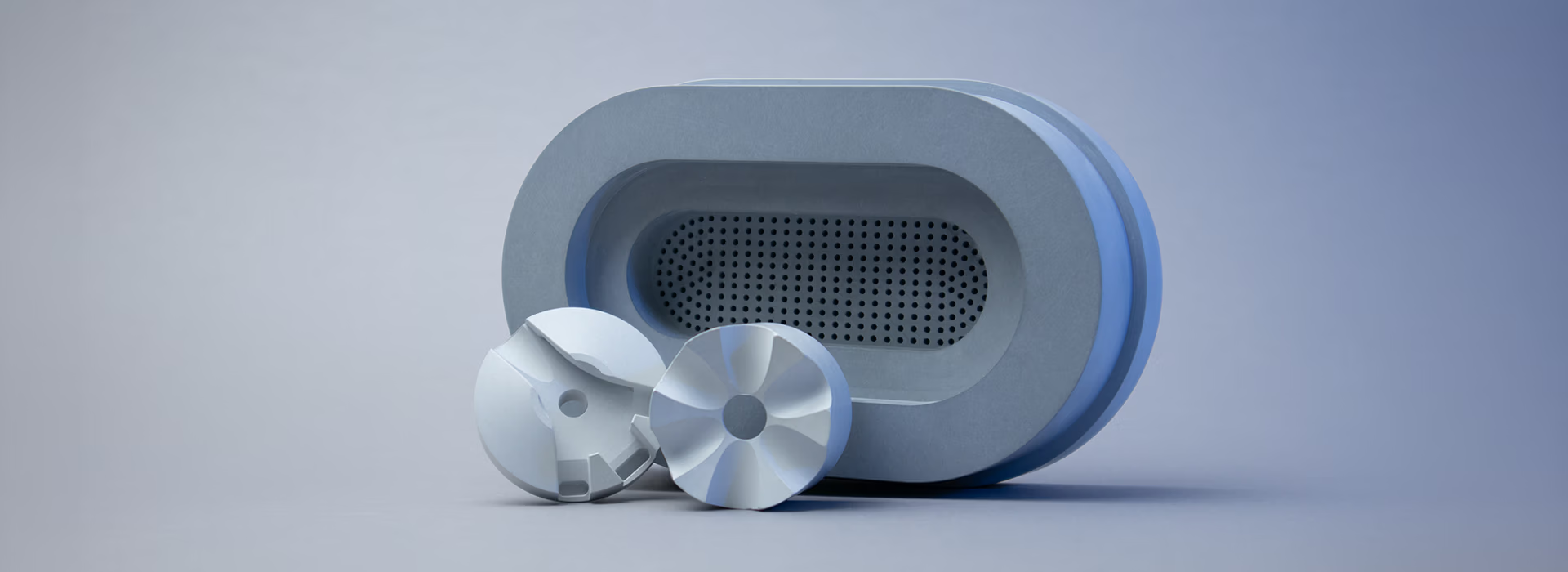
- HeBoSint® (components): Sintered precision components that are easy to machine, capable of withstanding extremely high thermal loads, and electrically insulating.
- HeBoCoat® (Coatings): Liquid coatings (water- or solvent-based) that ensure optimal release and lubrication properties on surfaces.
- HeBoFill® (powder): Versatile powders that, among other things, improve the thermal conductivity of plastics when used as fillers.
- HeBoLub® (lubricant additive): A dispersion of highly concentrated, fine boron nitride particles in oil that effectively minimizes friction and wear.
Is boron nitride an alternative to PTFE or PFAS?
Yes, absolutely. If you want to prepare early for a potential PFAS ban and are looking for a PTFE alternative, boron nitride is the ideal solution. It is physiologically safe, highly compatible with plastics and seals, and retains its lubricating properties even under the most extreme conditions.
Can boron nitride be used in the food industry?
Yes, we offer specialized products for sensitive applications. Our HeBoFill® LL-SP 010 and HeBoFill® LL-SP 050 powders are NSF-certified (Category HX-1). They are approved for use in lubricants where incidental food contact may occur, making their use in and around food processing facilities both safe and feasible.
Where are the boron nitride products manufactured?
We manufacture our boron nitride products directly at our facility in Lauben in the Allgäu region (southern Bavaria)—genuine “Made in Germany.” We place great emphasis on sustainability: for example, thanks to a sophisticated energy recovery system, we are able to produce boron nitride sintered bodies using renewable energy.
In which applications is the thermal shock resistance of boron nitride particularly important?
Its outstanding thermal shock resistance is in demand across a wide range of industries, but particularly in metal casting and high-temperature furnace construction. In metal casting, it is used to manufacture durable crucibles, nozzles, and molded parts that significantly extend the service life of tools and enhance process reliability. In furnace construction, the material ensures reliability in the form of electrical insulation sleeves, heater supports, or thermocouple protection tubes, despite constant temperature fluctuations.
How do Henze BNP boron nitride products perform under extreme temperature fluctuations?
Boron nitride products, particularly our HeBoSint® materials, are inherently highly resistant to thermal shock. They can easily withstand sudden and extreme temperature changes without losing their structural integrity. As a result, they ensure efficient and completely safe process control, even under high-temperature conditions.
What causes high thermal shock stress in industrial processes?
Extreme temperature fluctuations are an inevitable part of nearly all high-temperature processes. Plant components and tools are usually heated up very quickly—often due to sudden contact with extremely hot media such as molten metal—and then cool down rapidly. These abrupt fluctuations place enormous stress on conventional materials and can lead to cracks or component failure.