Hexagonal boron nitride as a non-stick solution
Challenge
Adhesions occur when metallic, glassy, or ceramic surfaces are exposed to high temperatures, pressure, or melting phases. This intensifies surface-energy interactions, leading to localized melting, diffusion, microdamage, and unstable boundary layer conditions.
Consequence
The adhesive interactions that occur in this process lead to material transfer, surface damage, and unstable process conditions. This results in increased scrap, tool wear, and maintenance costs, while process stability decreases. As thermal and mechanical stress increases, the tendency for adhesion intensifies significantly and becomes a critical factor for cost-effectiveness and component quality.
THE HENZE SOLUTION
Hexagonal boron nitride possesses exceptional non-wetting properties that form a stable, anti-adhesive surface even at extreme temperatures of up to 2,200°C. Its layered structure, low surface energy, and chemical inertness toward molten metals and glass effectively prevent material adhesion and ensure low-friction processes. The result is significantly reduced adhesion, leading to greater process reliability, higher component quality, and noticeably improved cost-effectiveness.
Haven't found a solution?
Our team is happy to assist you.
Frequently Asked Questions
What is boron nitride?
Boron nitride is a high-temperature-resistant industrial ceramic. It is a true all-rounder and is characterized by a unique combination of properties: It offers good anti-seizing and lubricating properties, excellent thermal conductivity, low thermal expansion, and outstanding electrical insulation properties. In addition, the material is highly resistant to thermal shock.
What is boron nitride used for?
Due to its versatile properties, boron nitride is used in numerous high-temperature applications and a wide variety of industries. Typical applications include sintering, powder metallurgy, and metal casting, where it serves as a release agent and protects against carburization. It is used in high-temperature furnace construction, aluminum extrusion, welding and laser processing, as well as in the production of thermally conductive plastics. Boron nitride has even proven itself under the extreme conditions of space, for example for electrical insulation in plasma thrusters for satellites.
In what forms does boron nitride come?
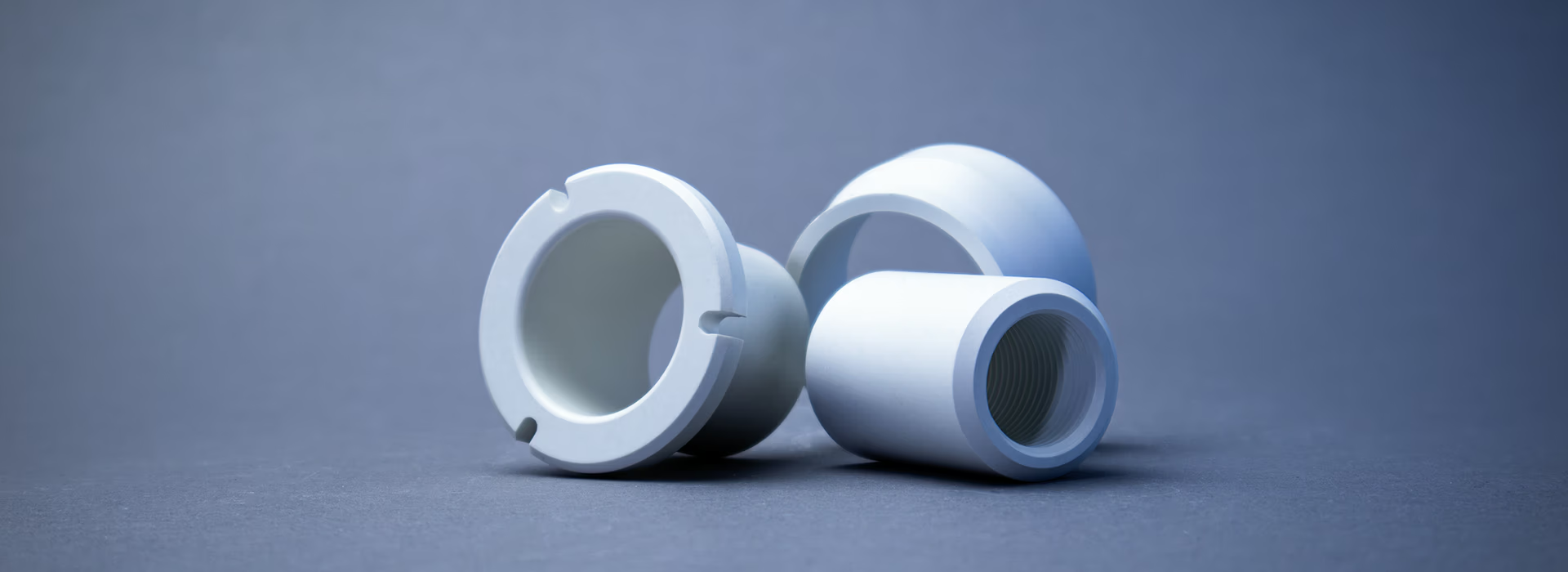
- HeBoSint® (components): Sintered precision components that are easy to machine, capable of withstanding extremely high thermal loads, and electrically insulating.
- HeBoCoat® (Coatings): Liquid coatings (water- or solvent-based) that ensure optimal release and lubrication properties on surfaces.
- HeBoFill® (powder): Versatile powders that, among other things, improve the thermal conductivity of plastics when used as fillers.
- HeBoLub® (lubricant additive): A dispersion of highly concentrated, fine boron nitride particles in oil that effectively minimizes friction and wear.
Is boron nitride an alternative to PTFE or PFAS?
Yes, absolutely. If you want to prepare early for a potential PFAS ban and are looking for a PTFE alternative, boron nitride is the ideal solution. It is physiologically safe, highly compatible with plastics and seals, and retains its lubricating properties even under the most extreme conditions.
Can boron nitride be used in the food industry?
Yes, we offer specialized products for sensitive applications. Our HeBoFill® LL-SP 010 and HeBoFill® LL-SP 050 powders are NSF-certified (Category HX-1). They are approved for use in lubricants where incidental food contact may occur, making their use in and around food processing facilities both safe and feasible.
Where are the boron nitride products manufactured?
We manufacture our boron nitride products directly at our facility in Lauben in the Allgäu region (southern Bavaria)—genuine “Made in Germany.” We place great emphasis on sustainability: for example, thanks to a sophisticated energy recovery system, we are able to produce boron nitride sintered bodies using renewable energy.
Why do unwanted deposits often form in industrial processes?
Whenever high temperatures, pressure, or molten materials come into contact with tools and components during the processing of metals, glass, or ceramic materials, unwanted deposits frequently form. These can disrupt the process, cause tool wear, and result in extremely labor-intensive cleaning tasks.
How do Henze BNP boron nitride products prevent materials from sticking?
Boron nitride is a true all-rounder and possesses excellent natural release and lubricating properties. The use of sintered HeBoSint® components, HeBoFill® powders, or liquid HeBoCoat® coatings creates an extremely temperature-resistant non-stick effect on the surfaces. This layer is chemically inert and reliably prevents process media or hot metal splashes from adhering to the components.
In which specific applications is the non-stick and release effect of boron nitride particularly in demand?
- Sintering technology: HeBoSint® substrates and HeBoCoat® coatings reliably prevent the sintered material from sticking to the substrate.
- Welding, soldering, and laser processing: These coatings protect welding nozzles, soldering tips, and workpieces from unwanted adhesion of welding spatter, solder spatter, and metal spatter. In laser processing, they also reduce burr formation, as molten residue can flow away more easily.
- Metallguss & PVD-Anlagen: HeBoCoat® verleiht Rinnenmaterialien im Guss den nötigen Trenneffekt und erleichtert die Reinigung. Auch metallische Abschirmrahmen in PVD- und Plasma-Anlagen lassen sich durch den Antihaft-Effekt deutlich leichter reinigen, was wertvolle Prozesszeit spart.